
Coursera is one of the few learning platforms that can work for two totally different people at the same time: the student who wants a low cost certificate from Google, IBM, or a top university, and the working professional who wants structured learning paths without hunting across random courses.
What makes Coursera different is not just the catalog size. It is the mix of university backed programs, job focused Professional Certificates, and subscription options like Coursera Plus that can be cost effective if you actually use it. The flip side is simple: Coursera can feel confusing at checkout because pricing depends on what you buy, and not everything is included in Coursera Plus.
Quick verdict
If you like guided learning with clear outcomes, quizzes, projects, and a certificate you can actually use on LinkedIn, Coursera is usually a strong pick.
If you prefer buying one course once and keeping it forever, or you want highly casual hobby learning, Coursera might not be your best value.
What Coursera offers
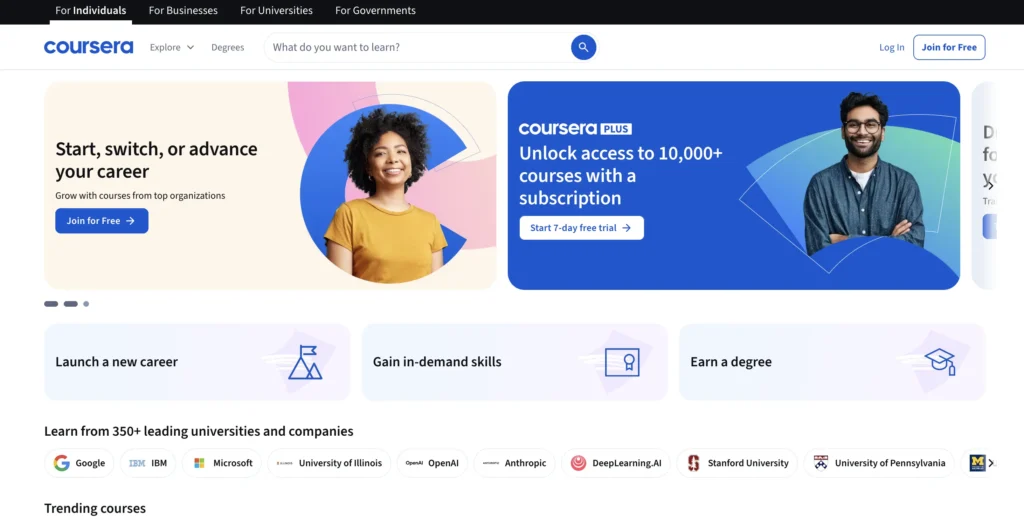
Coursera is built around a few product types, and each one has its own pricing style:
- Single courses: Many can be audited for free, but certificates usually require payment.
- Specializations: Multi course series, typically billed as a monthly subscription.
- Professional Certificates: Job focused programs (often from brands like Google), usually billed monthly like a subscription.
- Coursera Plus: A subscription that unlocks a large part of the catalog, but not everything.
- Degrees and MasterTrack: Higher ticket programs with separate pricing.
Most people reading a “Coursera review” are deciding between Coursera Plus vs paying per program. So let’s start with pricing in a clean, transparent way.
Coursera pricing in 2026 (exact plans and what they cost)
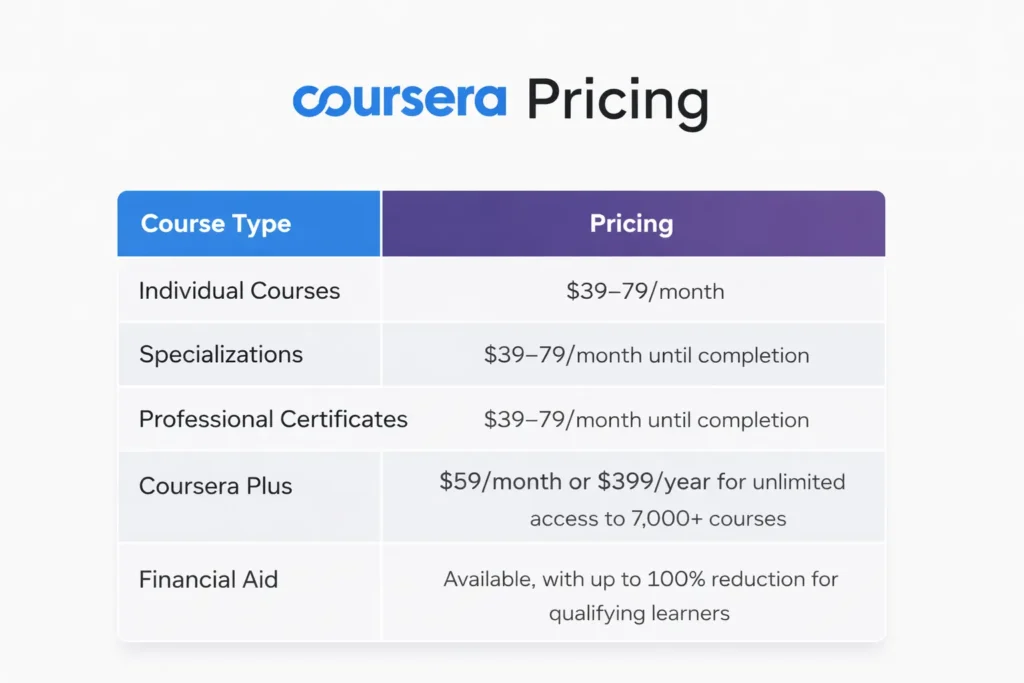
Pricing table
| Plan or purchase type | Typical price | Best for | Notes |
|---|---|---|---|
| Coursera Plus (Monthly) | $59 per month | People doing multiple courses in a short window | Includes a 7 day free trial, cancel anytime |
| Coursera Plus (Annual) | $399 per year | Serious learners who will use Coursera all year | 14 day money back guarantee listed for annual plan |
| Coursera Plus (India localized) | Rs 2,099 per month or Rs 13,999 per year | India based learners who want better local value | Reported as localized pricing for India |
| Coursera for Teams | $399 per user per year | Companies training 5 to 125 users | Team plan pricing shown publicly |
| Specialization or Professional Certificate subscription | Varies by program | You want one career track, not a huge library | Coursera supports monthly subscriptions for these |
A couple of important clarifications that save people money:
1) Coursera Plus is not “everything on Coursera”
Coursera Plus covers a large catalog, but some programs are excluded (common examples include many degrees and some partner programs). The practical takeaway: check the course page for the Coursera Plus badge before you assume it is included.
2) Monthly vs annual is a pure math decision
If you plan to learn for more than about 7 months, annual usually wins in the US pricing model: $59 times 12 is $708, while annual is $399.
If you are in India and the localized annual price is Rs 13,999, the annual option can become even more attractive if you will use it consistently.
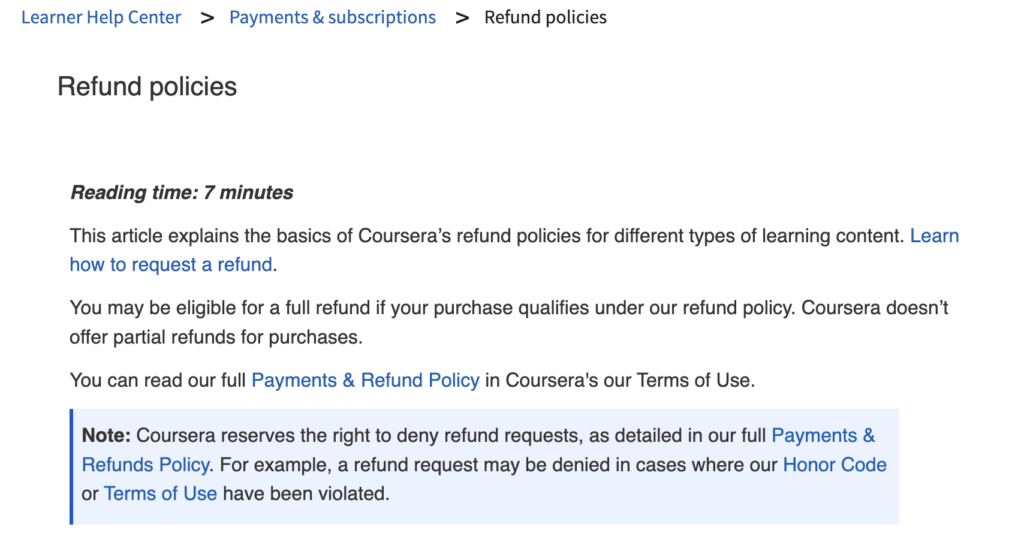
3) Refund rules matter, especially around trials
Coursera’s help pages spell out two key points:
- If your 7 day free trial ends, you generally are not eligible for a refund after that point.
- Coursera Plus annual mentions a 14 day money back guarantee, which is different from the monthly free trial behavior.
This is why I tell people to set a calendar reminder for day 5 or day 6 of the free trial. Decide early if you will commit.
Features: what you get when you pay
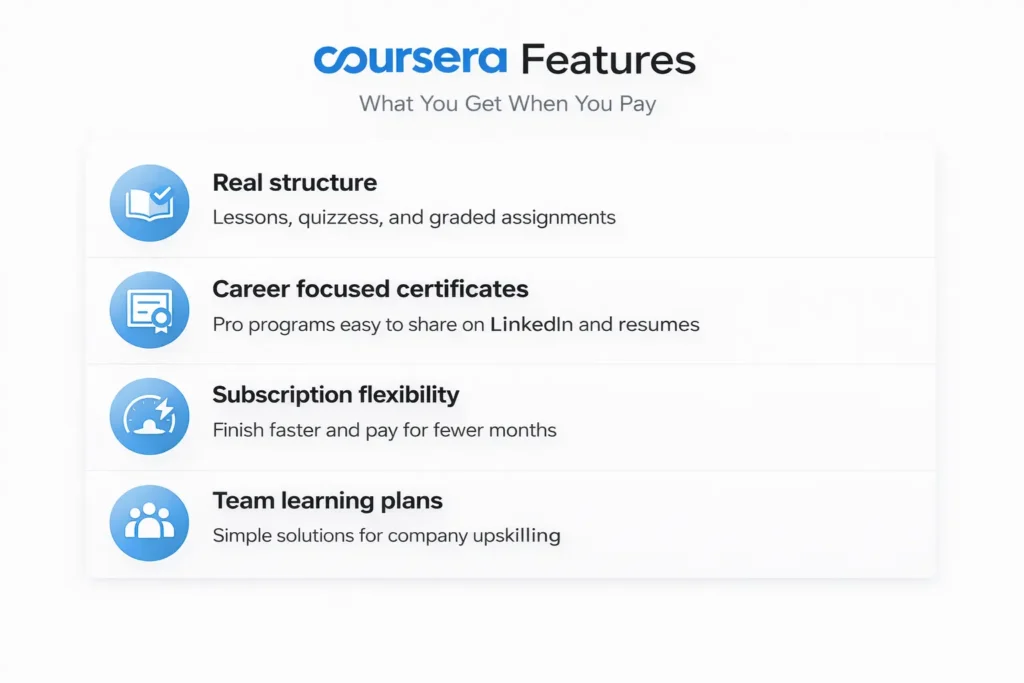
Coursera is strongest when you want structured learning, not random video watching. Here are the features that consistently show up across popular programs.
1) Real structure: lessons, quizzes, and graded assignments
Many Coursera programs include graded quizzes and assignments, not just videos. That matters because it forces momentum and helps retention.
2) Career focused certificates that are easy to share
Coursera is known for professional programs from well known companies and institutions, and certificates are designed to be shared on LinkedIn or on a resume.
3) Subscription flexibility for faster learners
If you are a fast learner, subscriptions can be a bargain. You can finish a Professional Certificate quicker and end up paying for fewer months.
4) Business plans for team learning
If you run a small team, Coursera for Teams is straightforward: it is priced per user per year and is built for structured upskilling.
Coursera pros and cons (honest, not fluffy)
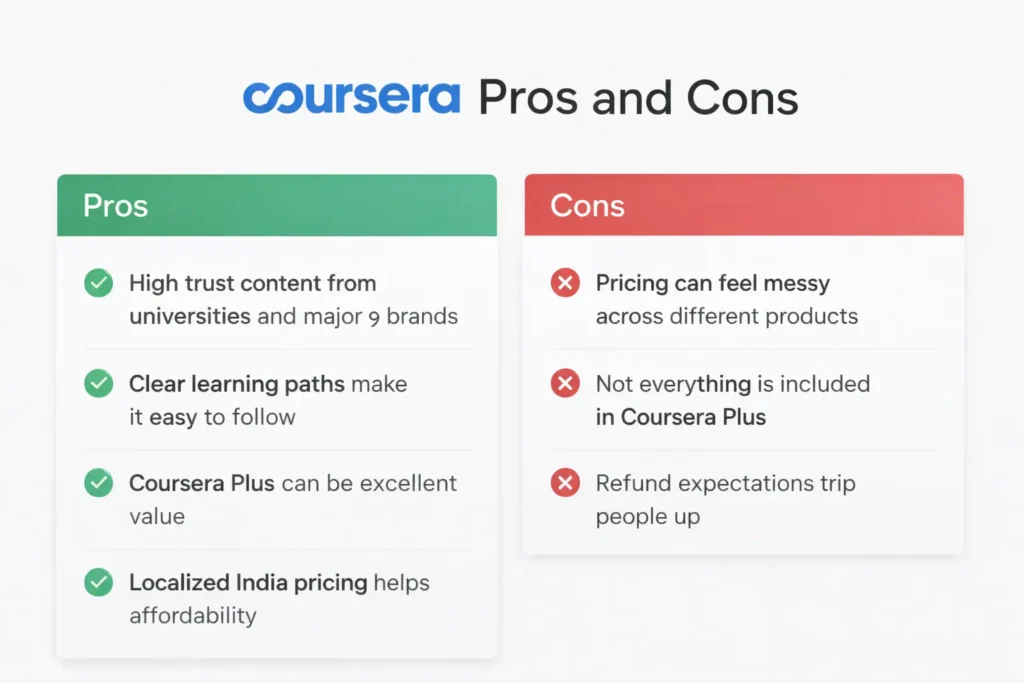
Pros
- High trust content because many programs come from universities and major brands
- Clear learning paths (especially certificates and specializations) that make it easy to follow
- Coursera Plus can be excellent value if you complete multiple courses
- Localized India pricing can make Coursera far more affordable for Indian learners
Cons
- Pricing can feel messy because different products have different billing
- Not everything is included in Coursera Plus, so you still need to check each program
- Refund expectations trip people up, especially after a free trial ends
Coursera vs similar platforms (early comparison)
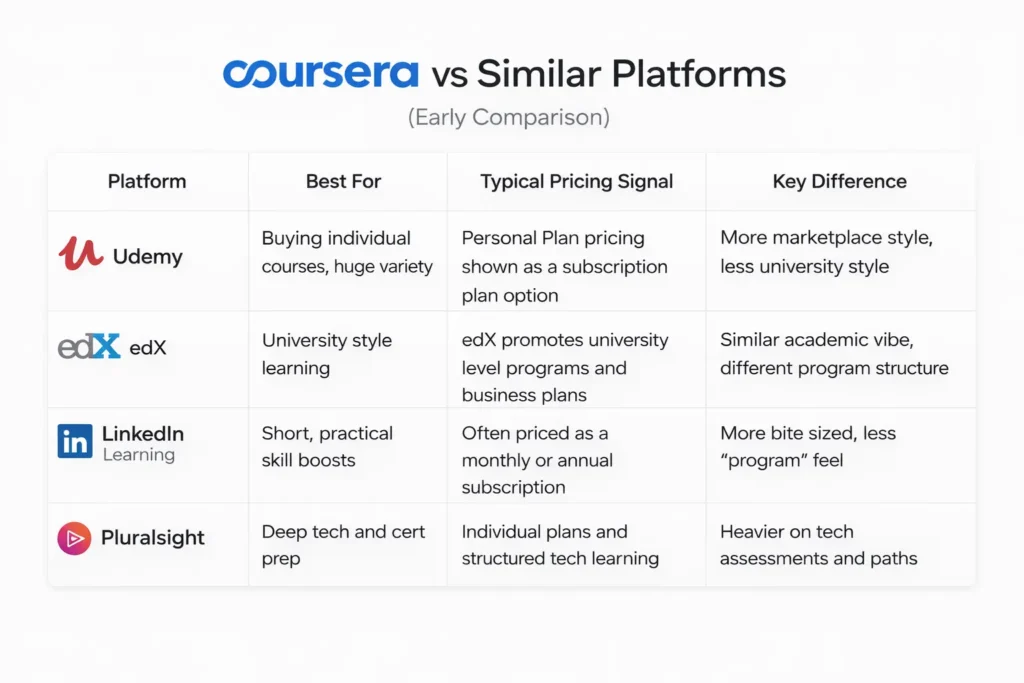
| Platform | Best for | Typical pricing signal | Biggest difference vs Coursera |
|---|---|---|---|
| Udemy | Buying individual courses, huge variety | Personal Plan pricing is shown as a subscription plan option on Udemy | More marketplace style, less university style |
| edX | University style learning | edX promotes university level programs and business plans | Similar academic vibe, different program structure |
| LinkedIn Learning | Short, practical skill boosts | Often priced as a monthly or annual subscription | More bite sized, less “program” feel |
| Pluralsight | Deep tech and cert prep | Individual plans and structured tech learning | Heavier on tech assessments and paths |
One extra industry note: Reuters reported Coursera announced plans to acquire Udemy in an all stock deal (expected close in the second half of 2026, subject to approvals). If that proceeds, the competitive landscape could shift over time.
Who Coursera is best for
Coursera is a great fit if you are in one of these situations:
- You want a job focused certificate with a clear syllabus
- You learn better with deadlines, quizzes, and assignments
- You want recognized providers rather than purely instructor marketplace courses
- You can commit to a learning sprint and potentially make a monthly subscription cost effective
What Is Included in Coursera Plus (And What Is Not)
This is where many learners get confused, so let’s simplify it.
Coursera Plus gives you access to a large number of:
- Individual courses
- Guided projects
- Specializations
- Many Professional Certificates
However, it does not include:
- Most full online degrees
- Some MasterTrack programs
- Certain partner programs that sit outside the subscription model
The easiest way to confirm inclusion is to look for the Coursera Plus badge on the course page before enrolling. If it is not marked as included, you will likely have to pay separately.
When Coursera Plus Makes Financial Sense
Coursera Plus becomes a smart decision in these cases:
- You plan to complete 2 to 4 certificates in a year
- You are exploring different skills and want flexibility
- You prefer one fixed annual payment instead of multiple subscriptions
If you only want one Professional Certificate and expect to finish it in two months, paying monthly for that specific program may be cheaper than the annual Plus plan.
Learning Experience: What It Feels Like to Use Coursera
A platform can look impressive on paper but feel frustrating in real life. Here is what the day to day experience typically includes.
Video Lessons
Most courses use short lecture videos broken into manageable sections. You can adjust playback speed and download transcripts. The format is structured and predictable, which many learners appreciate.
Quizzes and Graded Work
Many courses include graded quizzes. Professional Certificates and Specializations often include:
- Peer reviewed assignments
- Capstone projects
- Skill based assessments
This structure adds accountability. It feels closer to a classroom than a video streaming platform.
Deadlines and Flexibility
Coursera uses soft deadlines. If you miss one, you can reset your schedule. This works well for busy professionals who need flexibility without losing structure.
Certificates
When you complete a paid course or program, you receive a shareable certificate. These can be added directly to LinkedIn and resumes.
For career focused learners, this matters more than casual learners.
Popular Career Tracks on Coursera
Coursera is widely used for career transition and upskilling. Some common areas include:
- Data analytics
- Digital marketing
- Project management
- Programming and IT support
- Business foundations
Professional Certificates in these areas often follow a step by step progression. That makes them easier to complete compared to random course collections.
Refund Policy and Billing Clarity
This is important.
- Monthly subscriptions renew automatically.
- Free trials convert to paid subscriptions if not canceled.
- Refund rules differ between monthly and annual plans.
If you enroll, set reminders. Treat it like a gym membership. Stay intentional.
Is Coursera Worth It in 2026?
Here is the honest answer.
Coursera is worth it if:
- You will complete structured programs
- You value recognized certificates
- You are disciplined enough to use a subscription properly
It is not ideal if:
- You rarely finish courses
- You prefer lifetime access after one payment
- You only need one short skill
The annual Coursera Plus plan can be excellent value for serious learners. The monthly model works for focused sprints.
Final Verdict
Coursera remains one of the strongest platforms for structured, career oriented learning.
It combines:
- Recognized institutions
- Practical professional certificates
- Subscription flexibility
- Global accessibility
Its biggest weakness is pricing complexity. But once you understand the system, it becomes predictable.
If you want a clear path instead of random video browsing, Coursera is usually a solid choice.
If you want casual, low commitment learning, another platform may fit better.
The key is simple: choose the pricing model that matches your learning pace. That alone determines whether Coursera feels expensive or like a bargain.