
Choosing between Coursera vs Udacity is not as simple as picking the cheaper option. Both platforms focus on career development, but they approach online education very differently.
One works closely with universities and global companies to deliver structured programs with academic backing. The other focuses heavily on tech skills and job-ready training through intensive programs called Nanodegrees.
If you are serious about upgrading your skills in 2026, especially in fields like data science, AI, business, or programming, this comparison will help you decide which platform fits your goals better.
Quick Comparison Table
| Feature | Coursera | Udacity |
|---|---|---|
| Course Providers | Universities & companies | Industry experts & tech companies |
| Certificates | University & professional certificates | Nanodegree certificates |
| Degree Programs | Yes | No |
| Focus Area | Broad subjects + tech | Primarily tech & digital skills |
| Pricing Model | Subscription + individual course | Monthly Nanodegree pricing |
| Financial Aid | Yes | Limited |
| Refund Policy | 7–14 days | 7-day refund window |
| Best For | Career growth across industries | Tech career specialization |
| Overall Value | Strong academic credibility | Intensive tech skill training |
Coursera Overview
What Is Coursera?

Coursera partners with top institutions like Stanford University, University of Michigan, and companies such as Google and IBM.
It offers professional certificates, specializations, guided projects, and even full degree programs.
Key Features
- University-backed certifications
- Professional certificate tracks
- Bachelor’s and Master’s degrees
- Guided projects
- Financial aid options
- Coursera Plus subscription
- Mobile learning app
Pros
- Strong academic credibility
- Recognized certificates
- Wide range of subjects beyond tech
- Flexible pricing options
- Financial aid available
Cons
- Subscription costs can add up
- Some programs have deadlines
- Less project-heavy than Udacity
Coursera Pricing in 2026
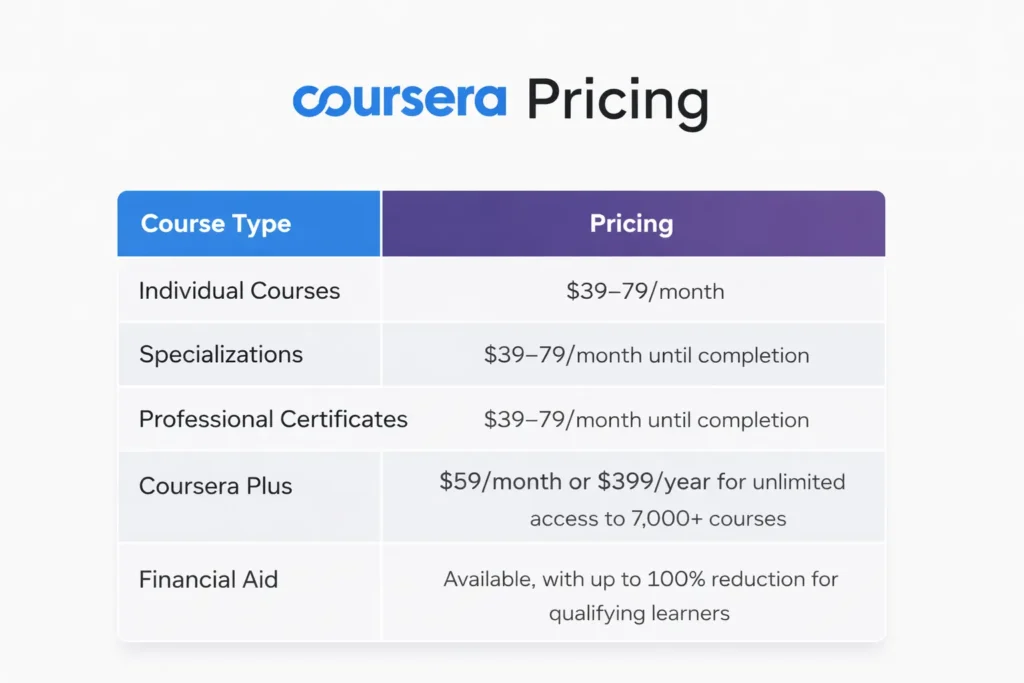
- Individual course: $39 to $79
- Specializations: $39 to $79 per month
- Coursera Plus: Around $399 per year
- Degree programs: Higher tuition depending on university
Coursera Plus is popular for learners taking multiple courses in a year. It offers access to thousands of programs under one plan.
You can check the latest discount for Coursera on our website. We regularly update working coupon codes for Coursera and Udacity.
Best For
- Professionals upgrading credentials
- Career switchers
- Learners who want academic recognition
- Students exploring multiple fields
Udacity Overview
What Is Udacity?

Udacity focuses heavily on technology-based skills. It is known for its Nanodegree programs that emphasize real-world projects.
Udacity collaborates with companies like Amazon and NVIDIA to design job-focused content.
Key Features
- Nanodegree programs
- Project-based learning
- Personalized mentor support
- Career services
- Tech-focused curriculum
Pros
- Strong tech specialization
- Real-world project portfolio
- Mentor guidance
- Career services support
Cons
- Expensive monthly pricing
- Limited subject variety
- No accredited degrees
- Smaller course catalog
Udacity Pricing in 2026
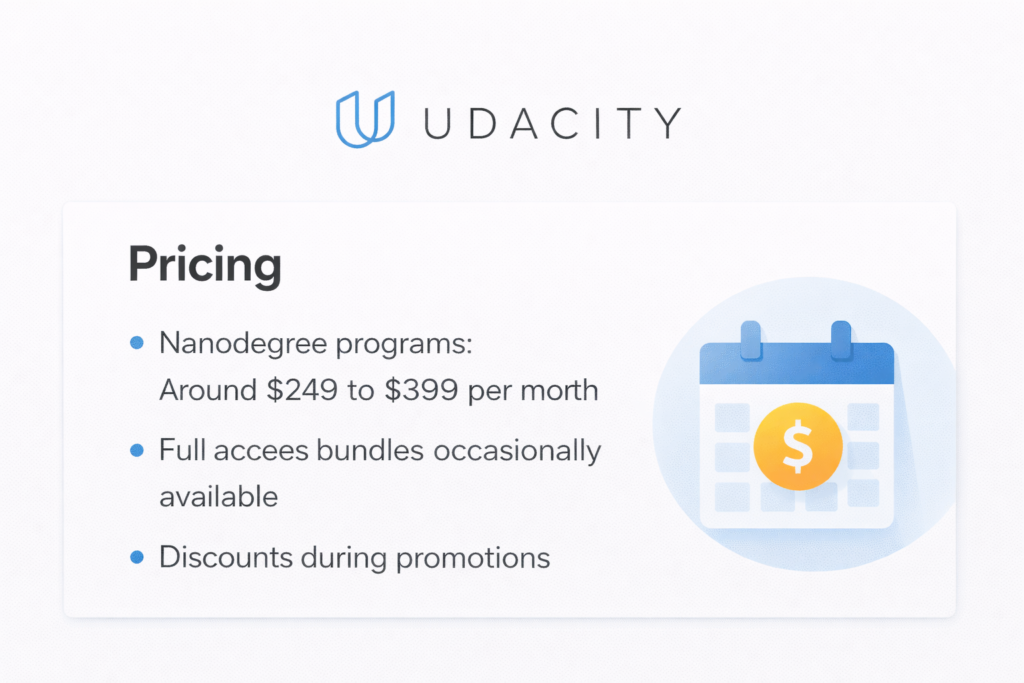
- Nanodegree programs: Around $249 to $399 per month
- Full access bundles occasionally available
- Discounts during promotions
Udacity pricing depends on how long you take to complete the program. Faster learners pay less overall.
Best For
- Aspiring data scientists
- AI and machine learning learners
- Software developers
- Tech professionals building portfolios
Feature-by-Feature Comparison
Pricing
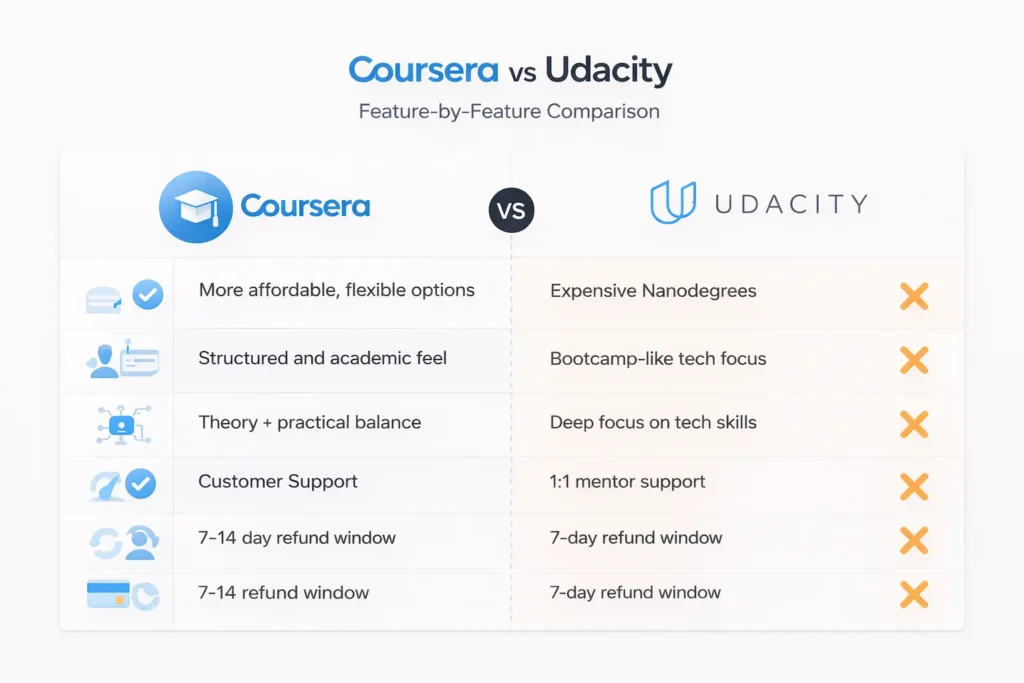
Udacity is significantly more expensive.
A Nanodegree can cost several hundred dollars per month. If a program takes four months, total cost may exceed $1,000.
Coursera offers more pricing flexibility. You can take single courses, subscribe monthly, or purchase annual access.
For budget-conscious learners, Coursera offers better flexibility and affordability.
Ease of Use
Both platforms are clean and easy to navigate.
Coursera feels like a structured academic platform with modules, quizzes, and peer-reviewed assignments.
Udacity feels more like a bootcamp. You work on projects and receive mentor feedback.
If you prefer guided academic learning, Coursera feels smoother. If you prefer hands-on technical projects, Udacity feels more immersive.
Course Quality and Depth
Udacity focuses deeply on tech skills. Its programs often include practical projects that simulate real work scenarios.
Coursera offers a balance of theory and practical knowledge, especially through university programs.
For pure tech immersion, Udacity may feel more intense.
For academic credibility and broader learning, Coursera provides more balanced depth.
Customer Support and Mentorship
Udacity provides mentor support in Nanodegree programs. This is one of its strongest advantages.
Coursera offers support but not always one-on-one mentorship unless part of a professional program.
If personal mentorship matters to you, Udacity has the edge.
Refund Policy
Coursera generally offers a 7 to 14-day refund window depending on the plan.
Udacity offers a 7-day refund window for Nanodegree programs.
Both platforms have limited refund flexibility once you start progressing deeply into programs.
Which One Is Better for Beginners?
For general beginners exploring different subjects, Coursera is easier.
It covers business, health, humanities, and tech. Beginners can experiment before committing to advanced tracks.
Udacity is more specialized. It suits beginners who already know they want to enter a tech career.
If someone is unsure about their career direction, Coursera provides more exploration opportunities.
Which One Is Better for Advanced Users?
Advanced tech learners may benefit from Udacity’s project-based Nanodegrees.
For example, someone preparing for a machine learning engineering role may appreciate Udacity’s focused technical curriculum.
However, advanced professionals who want university-backed credentials often prefer Coursera.
If your goal is industry projects and portfolio building, Udacity works well.
If your goal is recognized certification and long-term academic credibility, Coursera remains stronger.
Real-World Use Cases
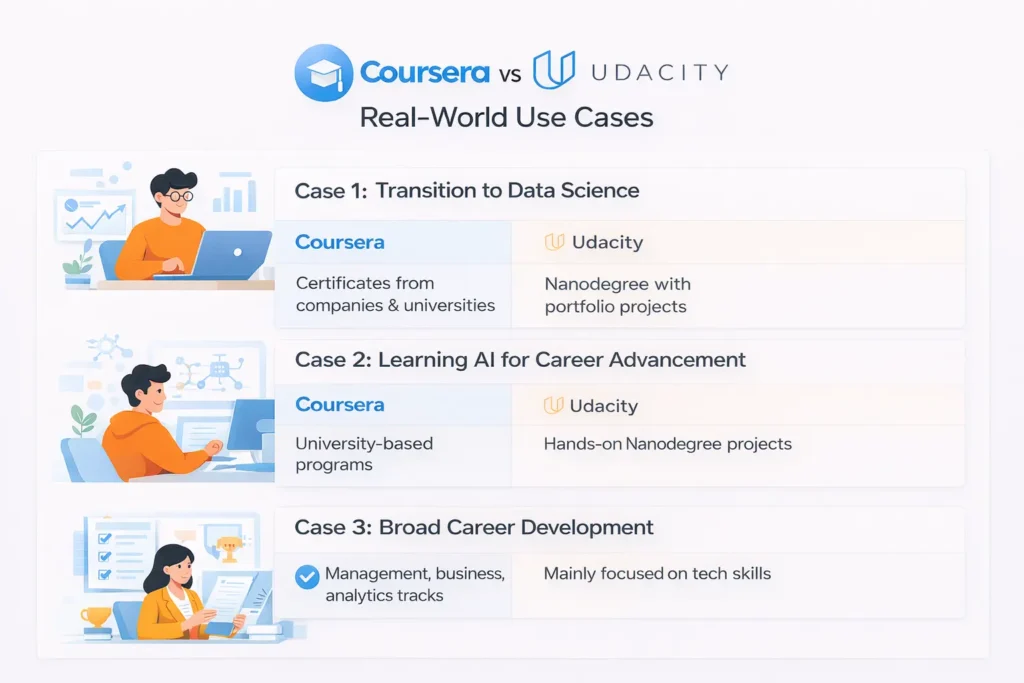
Case 1: Transition to Data Science
A marketing professional wants to move into data science.
Udacity offers a Data Scientist Nanodegree with portfolio projects.
Coursera offers professional certificates from companies like Google and IBM, plus university-based data science programs.
If the learner wants structured credibility and possible academic progression, Coursera provides more flexibility.
Case 2: Learning AI for Career Advancement
A software engineer wants to specialize in AI.
Udacity’s AI-focused Nanodegree includes hands-on projects.
Coursera offers AI programs from universities with theoretical grounding.
Udacity is stronger for project-heavy experience. Coursera is stronger for academic recognition.
Case 3: Broad Career Development
A business graduate wants to build skills in analytics, management, and communication.
Udacity’s catalog is limited mostly to tech.
Coursera offers management, leadership, and business analytics programs from global universities.
Coursera clearly wins for broad career development.
Is Coursera Better Than Udacity in 2026?
For pure tech specialization and project-based training, Udacity performs well.
For flexibility, academic credibility, pricing options, and broader career development, Coursera offers more overall value.
So is Coursera better than Udacity?
For most learners in 2026, yes.
It provides stronger recognition, more subject variety, and better long-term growth opportunities.
Final Verdict: Coursera vs Udacity
Both platforms are strong, but they serve slightly different audiences.
Udacity focuses on intensive tech training with project experience.
Coursera provides structured learning backed by universities and global companies across multiple industries.
If you are fully committed to a specific tech path and value project mentorship, Udacity is solid.
If you want flexible learning, recognized certificates, and broader career options, Coursera is the smarter choice.
For most learners, especially those planning long-term growth, Coursera offers better overall value.
You can check the latest discount for Coursera on our website. We regularly update working coupon codes for Coursera and Udacity.
FAQs
1. Is Coursera better than Udacity for data science?
Coursera offers recognized certifications and academic pathways. Udacity offers strong project-based training. For long-term recognition, Coursera has an advantage.
2. Are Udacity Nanodegrees worth it?
They can be valuable for tech professionals who want hands-on project experience and mentor guidance.
3. Which platform is more affordable?
Coursera generally offers more flexible and affordable pricing compared to Udacity’s monthly Nanodegree model.
4. Does Udacity offer accredited degrees?
No. Udacity provides Nanodegree certificates but not accredited university degrees.
5. Is Coursera good for career switching?
Yes. Coursera’s professional certificates and university programs are helpful for career transitions.
6. Which platform is better in 2026 overall?
For broader learning, academic credibility, and long-term value, Coursera remains the better choice for most learners.